

How Much Money Was Spent To Build The Boeing 737
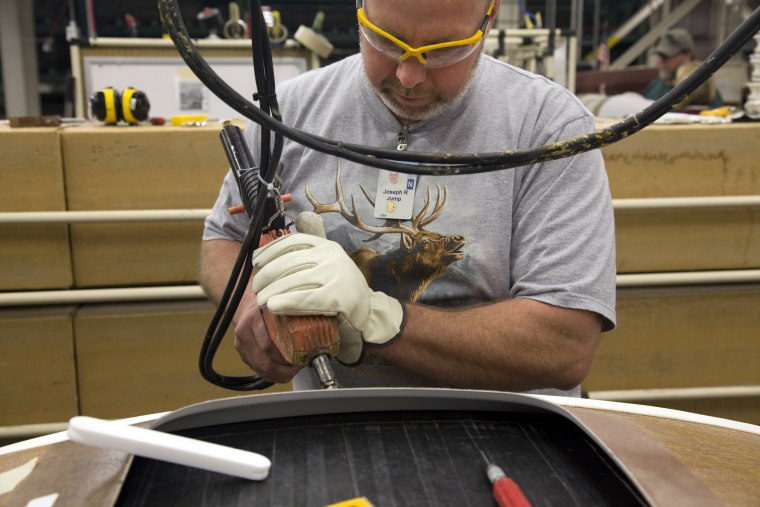
GM Nameplate isn't exactly a household name, just its products are well-known to anyone who has flown on a Boeing aeroplane in recent years.
From a midsized room in a nondescript Seattle building, the family-owned company produces a vast array of graphics that go into Boeing airplanes, from the signs telling passengers where their seats are to the technical instructions for pilots and mechanics.
In all, it amounts to more than than a one thousand thousand pieces a year, each meeting a specific airline's color, branding and language specifications. Just getting the correct hue of white to match each airline's interior walls can be a challenge.
"It's amazing how many dissimilar formulations nosotros have," said Greg Root, president of the visitor'south superGraphics division.
Boeing Co. is one of the nation's biggest and best-known manufacturers, employing 158,000 workers and producing tens of billions of dollars worth of commercial jets and defense systems annually for customers worldwide. Just to assemble just one model of airplane — the 737, its smallest and most popular commercial jet — the company relies on a complex web of hundreds of suppliers providing everything from engines and fuselages to seats and exit signs.
"We tin can't be experts in everything," said Helene Michael, vice president of manufacturing operations for the 737 program.
Instead, Boeing likes to retrieve of itself as an expert in getting all the parts in the right place at the right time, and then putting them together quickly.
"Nosotros kind of pride ourselves on beingness a big-scale systems integrator," said John Hamilton, chief engineer for the 737 programme.
While information technology can make skillful financial sense to integrate parts rather than build everything in-house, Boeing has learned the hard way — via its much-delayed 787 program — that at that place are likewise serious risks in relying as well heavily on others. But with the commercial plane industry poised to grow more competitive, and cash-strapped airlines looking for any style to pinch pennies, making airplanes cheaper and more efficiently may be the merely way manufacturers can survive.
"The more efficient we get, the longer nosotros stay in the phone book," Michael said.
The 737, which is made upwards of 367,000 parts, is assembled at a manufacturing plant in Renton, Wash., s of Seattle. Boeing delivered 372 of the single-aisle 737s concluding year — a little more than one a day. Its primary rival, Europe'south Airbus, delivered 402 of its comparable A320 family of planes in the same period.
Faster, cheaper, better
To appeal to airlines and compete with Airbus, Boeing has not hesitated to outsource when in that location may be a price savings. About 5 years agone, it even went so far as to spin off the Wichita, Kan., operation that makes 737 fuselages and other airplane parts. That at present-independent company, Spirit Aerosystems, also does piece of work for competing aerospace companies.
In part because Boeing serves and then many large international airline customers, the company also relies heavily on international suppliers. Among major suppliers, Prc'south Xian Aircraft Co. makes the some 737 vertical fins, and Japan's Mitsubishi Heavy Industries provides the wing's inboard flaps.
"We recognize we can't build every single slice of the plane in America," Michael said.
But as i of the nation's acme exporters and a major defense contractor, Boeing also recognizes the importance of keeping its assembly factories on U.S. soil.
Fragile balance
Boeing executives admit that it can be tough to observe the right remainder between what it makes at its own plants and what it acquires from outside companies.
The visitor has conceded it tipped too far in the wrong direction with the 787, which is undergoing test flights some 2 years behind schedule. Boeing relied extensively on other companies to both design and build 787 components, in part to alleviate the brunt of financing such a big project. But the all-encompassing outsourcing led to communication snafus and delays.
Aerospace analyst Richard Aboulafia of the Teal Group said the lesson from "the great fiasco of the 787" is that information technology'southward not only what you lot outsource, information technology'southward also how you outsource. He said Boeing failed by giving outsiders likewise much responsibility for designing integral parts of the aircraft.
Still, Aboulafia said that doesn't hateful information technology's a bad idea to dissever the work — and share the cost — of building an aircraft. He notes that airplane makers ever rely on exterior suppliers to build engines, i of the almost of import components in an aircraft, and the organization has been highly successful.
Get an exclusive within await at the production of the Boeing 737.
"You look at the companies in the world that kept it all in-house, and it'due south more likely to be General Motors and less likely to be Apple," he said.
Motility to 'lean' manufacturing
The 737 product lines stretches downwards ii sides of a edifice then large some workers use oversized tricycles to go from ane end to some other. On a typical solar day, the moving line of green-hued, unpainted airplanes chugs forth at almost 2 inches a infinitesimal, every bit workers install the thousands of parts that transform the fuselage from an empty shell to a flying-ready auto.
Employees piece of work around the clock five days a week on multiple airplanes, producing 31.5 new 737s a month, with each 737 meeting in 11 days. About ix,800 employees work in the Renton facility on both the 737 program and the P/8A Poseidon, a armed forces version produced for the Navy.
Rival Airbus produces 34 of its narrow-torso A320s per month, and plans to heighten that to 36 in December
It wasn't always this way. In the late 1990s, after a crisis then groovy that Boeing actually briefly shut downwards the plant, the visitor began a drastic overhaul of the Renton facility.
Between 2000 and 2006, relying on the type of "lean" manufacturing principles pioneered by carmaker Toyota, Boeing made the gradual shift from building 737s at stations to running a moving production line.
Seemingly pocket-size changes resulted in major efficiency gains.
Instead of spending an hour or two assembling the equipment they demand for the day, Boeing factory workers now arrive at work to find a kit containing all the screws, hammers and other instruments they volition need to become their specific jobs done.
Boeing also moved all the engineers who work on the 737 into offices that literally overlook the factory floor. At present if a worker has an issue, engineers can be at the scene in simply a few minutes vs. the peradventure daylong lag when engineers were in other buildings.
Such changes accept cut the amount of time it takes to produce a 737 in half, from 22 days to 11. Michael'south ultimate goal is to cut the production time to viii days per plane.
Competitive threats
The company says such improvements may be necessary to its survival.
The diverse 737 models business relationship for about 33 percent of all Boeing and Airbus planes flying today, according to Forecast International. But while Boeing has chiefly competed with Airbus until now, the company is facing looming threats from a slate of potential competitors who are developing similar airplanes in China, Russia, Brazil and Canada.
Although Boeing and Airbus are the key players in the large commercial plane market right at present, aviation consultant Mike Boyd notes that several of the programs in development could apace play catch up.
"Things tin can change really quickly," he said.
The airplane maker'due south efficiency push has a ripple effect on Boeing suppliers. GM Nameplate, the graphics supplier, said it is sometimes asked to rush an social club from its Seattle plant to the Renton facility in just a few hours, so product tin can keep flowing despite an unexpected change in an airline'south needs.
GM Nameplate has product facilities in China and Singapore only said it would non make sense to make the products for Boeing there.
"It'd cost more to ship it back than information technology would to produce information technology here," said Brad Root, president of GM Nameplate'south Seattle division.
Even Boeing's ain units say they experience the pressure.
Internal suppliers
On a recent weekday morning, Brian Crabtree was at work at Boeing'southward Interiors Responsibleness Center in Everett, n of Seattle, pulling new 737 interior panels from an industrial oven.
Past the cease of the solar day, near 100 of those panels would exist completed and shipped 30 miles due south to the 737 found in Renton to exist installed on a new airplane, perhaps as early as that evening.
The quick turnaround leaves piddling inventory sitting around, which saves money.
The Interiors Responsibleness Center may exist a Boeing facility, but Beth Anderson, its director, thinks of herself as the 737 plant's supplier.
"They could go outside and do it somewhere else," she said.
This isn't just idle talk; in the tardily 1990s, Boeing'south 767 program did opt to go elsewhere for its interiors.
"We realized that we don't automatically get to practise this work," Anderson said. "We take to testify ourselves."
Hamilton, the 737 engineer, concedes the visitor could move its interiors manufacturing to an overseas supplier just said the Boeing unit has been able to stay competitive.
"Correct now, nosotros believe that making those locally is the right affair to do," he said.
Disarming workers
As Boeing has grown more efficient, executives concede information technology has been tough to convince mill workers that they aren't going to improve themselves out of a job. Hamilton said the 737 factory has had some layoffs merely has tried to skin its staff through compunction from retirement, and by not hiring more workers when product levels rise.
The union representing Boeing factory workers, the International Clan of Machinists, said the company employs iv,050 Machinists in Renton, working on both the 737 and the Navy'southward P/8A.
In July 2001, prior to a major commercial airplane downturn following the Sept. 11 terrorist attacks, union spokeswoman Connie Kelliher said Boeing employed six,022 Machinists in Renton, working on both the 737 and 757, which is no longer in product.
Boeing said Machinists employment has dropped considering the company phased out the 757 and fabricated productivity improvements.
James Cairns, a shop supervisor who overseas installation of the interior walls, said that he didn't necessarily see the vision when Boeing began working toward the moving line nearly 10 years agone. Merely now, he said, he's come to capeesh that product runs more smoothly and is safer, considering workers are no longer crowded together among a multitude of toolboxes, hoses and ladders.
"There is no way I'd desire to go dorsum to how we used to build the planes," he said.
Still, non everyone is convinced all aspects of lean manufacturing are paying off. Crabtree, who works on the interior panels, said his unit's new moving line, which relies on then-called "tugbots" that the visitor designed in-house, breaks down more frequently than the erstwhile chain system and is not equally ergonomic as it could be.
Crabtree worries that things like the tugbots are just going to finish up costing Boeing more than money and increasing the chances the company will move his chore to a place where the parts tin be made more than cheaply using non-union labor.
Those fears have been augmented by Boeing's plan to open a 2nd 787 associates line in South Carollina, where labor is likely to be much cheaper than the unionized work forcefulness in the Seattle surface area.
"I like lean — there'due south adept ideas — but the best ideas come from people upwards here," Crabtree said, gesturing to his fellow workers in the plant. "They don't utilise our ideas."
Boeing says that it has incorporated some ideas from the manufacturing plant floor into its plants. Following an employee'south suggestion, the company bought and modified a hay baler to use for loading seats onto a 737.
Re-engine, or rethink?
Every bit the 737 model ages and faces increased contest, bigger changes are likely on the horizon. The visitor is currently evaluating whether to innovate a new, more efficient engine to the aircraft, a motion that would require other major design changes.
The company also could motion to a completely new airplane blueprint, a costly undertaking that may be difficult as information technology is nevertheless flight-testing the brand new 787, the wide-torso 747-8 and the P/8A for the Navy. In add-on, Boeing is gearing upwardly to launch a new interior for the 737.
Nevertheless, the potential for such changes accept left some worried that Boeing volition choose to make future narrow-body aircraft in another part of the U.S., or even some other country.
"What Washington country has to worry about, and I suppose America, is what Boeing decides to do with those replacement airplanes," said aerospace analyst Scott Hamilton with Leeham Co.
John Hamilton, the 737 engineer, said he doesn't envision the company moving its assembly whatever fourth dimension soon.
"I think we'll go along to build the airplane in the U.S. for a long fourth dimension," he said.
Gesturing toward the Renton factory floor, where workers hovered around the glistening line of 737s, he said: "You tin't readily indistinguishable that overseas."

Source: https://www.nbcnews.com/id/wbna36507420
Posted by: vanhoutencama1993.blogspot.com
0 Response to "How Much Money Was Spent To Build The Boeing 737"
Post a Comment